

Making Sense of the Software, Crypto, and Payments Sell-Off
Last week’s sharp sell-off across software, payments, and cryptocurrencies caught many investors’ attention. The move felt sudden and dramatic. While these types of market swings can be unsettling, they are often best understood through a simple but important lens: innovation and disruption are two sides of the same coin.
Every major technological advance creates new opportunities while simultaneously challenging existing business models. Markets rarely price this transition smoothly, and periods of volatility are often the result.
More than fifteen years ago, venture capitalist Marc Andreessen famously said that “software is eating the world.” Over time, that prediction proved accurate as software reshaped entire industries. Today, artificial intelligence represents the next phase of that same process. It is already driving both enthusiasm and uncertainty across financial markets.
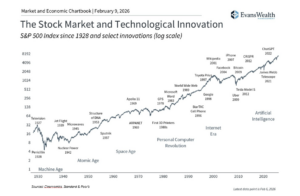
As shown in the stock market and technological innovation chart, major technological shifts often bring short-term market uncertainty. Over time, however, the direction has been consistent: innovation drives productivity, earnings growth, and long-term market returns.
Why software came under pressure
Recent advances in AI-driven automation have demonstrated the ability to perform tasks previously handled by specialized software products, particularly in areas such as legal and financial research. This has prompted investors to reassess which software companies stand to benefit from AI and which may face disruption.
At the same time, several large technology companies have significantly increased capital spending on AI infrastructure. In innovation cycles, this phase often reflects the tension between long-term potential and near-term uncertainty around returns. When valuations are elevated, that tension can quickly show up in stock prices.
The resulting sell-off and subsequent rebound illustrate how markets often react when innovation accelerates faster than clarity.
Why payments and crypto were pulled in
Although AI-related headlines were the initial catalyst, the selling pressure extended beyond software. Fintech payment firms were hit particularly hard as weaker results and lowered expectations, most notably at PayPal, shook investor confidence across the sector and amplified concerns around growth and valuation.
In the case of cryptocurrencies, the move was likely amplified by the structure of the market itself. A significant portion of crypto trading is driven by leveraged positions and algorithmic strategies, which can trigger mechanical selling as prices decline. When volatility rises, these dynamics often accelerate both sell-offs and rebounds, independent of longer-term fundamentals.
Here again, innovation and disruption move together. New technologies can expand long-term opportunity, but the transition often brings periods of elevated short-term volatility.
A familiar pattern in periods of disruption
While the current focus on AI may feel unprecedented, history suggests otherwise. From railroads and electricity to the internet, technological progress has always followed a similar pattern. Markets first wrestle with disruption before ultimately benefiting from innovation.
Importantly, even the most transformative technologies do not eliminate the need for infrastructure, trusted platforms, and specialized expertise. Instead, they reshape how value is created and distributed over time.
What this means for investors
Recent market volatility reinforces several long-standing investment principles:
- Innovation creates opportunity, but disruption creates uncertainty
- Technology-oriented sectors can experience sharp swings as expectations adjust
- Diversification and asset allocation matter more than any single trend
While AI is likely to play a meaningful role in future growth, it is only one part of a much broader investment landscape.
The bottom line
Last week’s sell-off was not a verdict on the future of software, payments, or cryptocurrencies. It was a reminder that innovation and disruption arrive together, and markets often struggle to price that reality in the short run.
History shows that those who maintain discipline, diversification, and a long-term perspective are best positioned to benefit as innovation ultimately translates into economic growth and market returns.