
Key Takeaways:
- Election results rarely change the economy’s direction as much as people expect.
- Many Americans feel worse about the economy than the data suggests, because higher prices still weigh on household budgets.
- Growth comes mainly from business innovation, investment and consumer decisions, not from Washington alone.
- With a divided government, big policy changes will likely need bipartisan compromise.
- Investors should focus on inflation, interest rates and earnings rather than on which party is in power.
The midterm elections have dramatically changed the political landscape in Washington, with Democrats gaining control of both the House and Senate. For some, that’s welcome news. For others, it’s cause for concern. But how much should we really expect the election results to change the direction of the economy?
Probably less than many people think.
I’ve long believed that presidents and Congress receive too much credit when the economy is doing well and too much blame when it struggles. Government policies matter, sometimes considerably. But the American economy is far larger, more complex and more resilient than any political administration.
The Disconnect Between Economic Sentiment and Reality
One of the more interesting aspects of this election is the disconnect between how Americans feel about the economy and how it’s actually performing.
Consumer sentiment has fallen to exceptionally low levels (see the accompanying chart), reflecting frustration with inflation, high borrowing costs and the erosion of purchasing power. Higher gasoline prices, mortgage rates and the cumulative effect of years of inflation have weighed heavily on household finances.
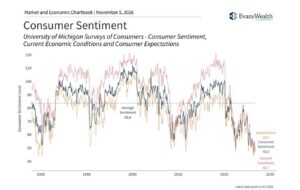
Yet the broader economy remains resilient. Consumer spending has held up, businesses continue to invest, and technological innovation, particularly artificial intelligence, is creating opportunities for growth. While some areas are showing signs of strain, the overall picture is considerably better than consumer confidence surveys suggest.
How do we reconcile these conflicting signals?
Economic growth doesn’t benefit everyone equally. Households with substantial financial assets have benefited from rising investment values, while families more dependent on wages have felt the pressure of higher living expenses. And even when inflation moderates, prices generally don’t return to previous levels. The rate of increase slows, but the higher cost of living remains.
There’s also a distinction between the economy as measured by statistics and the economy as experienced by households. A family struggling with higher insurance premiums, grocery bills and mortgage payments isn’t likely to feel better because GDP growth exceeds expectations.
That frustration can have enormous political consequences without necessarily signaling an economic downturn. The conditions that influence how people vote aren’t always the same conditions that determine how businesses and financial markets perform.
The Economy Is Bigger Than Washington
We tend to view economic performance through a political lens. When the economy is strong, the party in power claims credit. When conditions deteriorate, the opposition points to failed leadership. But the forces driving our economy are considerably more complex.
Long-term growth depends on businesses developing new products, entrepreneurs taking risks, workers becoming more productive, companies investing in technology, and consumers making millions of individual decisions. Global trade, demographic changes, interest rates and the business cycle also play important roles.
Government can influence the environment in which these decisions are made, but it cannot dictate their outcomes. A favorable tax policy doesn’t guarantee investment, just as a new regulation doesn’t necessarily prevent innovation. The economy isn’t a machine that Washington can simply accelerate or slow at will.
Of course, government policies matter. Taxes, regulations, trade and federal spending can meaningfully influence business investment and economic activity, sometimes with consequences extending well beyond the administration responsible for them.
Yet the American economy has experienced expansions, recessions and remarkable innovation under both political parties. Through it all, its long-term direction has been one of growth.
What Changes Following the Election?
With Democrats controlling Congress and Republicans retaining the White House, sweeping legislative changes will likely require bipartisan compromise. Negotiations over taxes, energy, trade, healthcare and federal spending will be particularly important for businesses and investors, potentially creating periods of policy uncertainty.
Looking ahead, I’m paying far more attention to inflation, interest rates, corporate earnings and business investment than to which party controls Congress. Those factors will likely have a more direct influence on economic growth and investment returns.
Artificial intelligence is a good example. Businesses are investing heavily in technologies that could improve productivity and create opportunities for growth. Government policy may influence those investments, but the underlying motivation comes from companies seeking to innovate and compete.
For investors, the distinction matters. Political developments can create short-term volatility, but long-term returns depend more on earnings, valuations, interest rates and economic growth. Even a healthy economy doesn’t guarantee attractive stock market returns if investors pay too much for future growth.
For investors, the challenge is separating political headlines from developments that materially affect earnings, valuations and long-term growth. Portfolio decisions should reflect those fundamentals rather than our hopes or concerns about which party holds power.
Keeping the Election in Perspective
The election results reflect genuine frustration with the cost of living and a desire for change. Whether the new political balance produces more effective economic policies remains to be seen. But the underlying forces driving growth won’t suddenly change because control of Congress has shifted.
America’s economic strength has never depended solely on who occupies the White House or controls Congress. It rests on the ingenuity of its people, the resilience of its businesses, the willingness of entrepreneurs to take risks and the ability of our economy to adapt.
We should hope our elected officials pursue policies that strengthen the economy and improve Americans’ lives. But our confidence in America’s economic future shouldn’t rise or fall with the fortunes of either political party.
Washington can influence our economic future. It doesn’t determine it.